
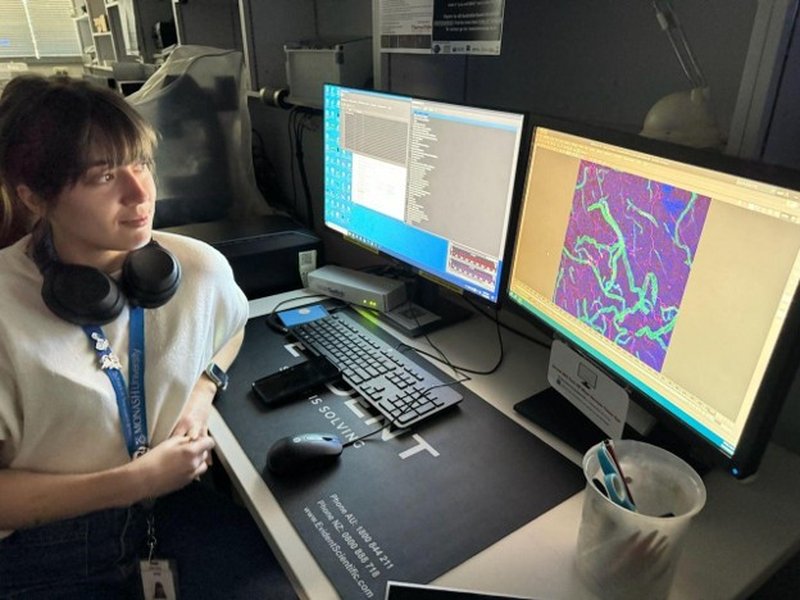
Where Science Blooms with researcher Ashleigh Paschek
What does a sunflower have to do with the hidden world of chronic UTI? The answer lies in an extraordinary meeting of science and art. Meet Ashleigh Paschek, a PhD researcher at Monash University who is investigating why some urinary tract infections persist and become chronic. In this interview, Ashleigh shares the science behind her striking sunflower imagery, her research into the body’s immune response to UTI and her hopes for the future of chronic UTI research.
Meet Australian UTI researcher and science art creator Ashleigh Paschek
What happens when scientific research meets art? For PhD scholar Ashleigh Paschek, the answer is a striking series of colourful images created from the microscopic world of the urinary bladder.
Ashleigh is undertaking her PhD with Dr Malcolm Starkey as part of the Urinary Tract Disease Research Group within the School of Translational Medicine at Monash University. Her research focuses on one of the less explored aspects of urinary tract infection: how the body’s immune system responds to infection.
Alongside her research, Ashleigh has developed a passion for scientific imaging and has created a series of immunofluorescence confocal images, including artwork inspired by flowers.
One of her most striking pieces transforms immunofluorescence images of the urinary bladder into a field of sunflowers.
For Ashleigh, the image is more than beautiful scientific imagery. The sunflower was deliberately chosen as a way of shining a light on chronic UTI—a condition that remains under-recognised despite its impact on so many people.
We spoke with Ashleigh about her research, her pathway into urinary tract science, the inspiration behind her science-art and what she hopes the future holds for UTI research.
Tell us about the research group you are part of. What does the team focus on?
I’m part of the Urinary Tract Disease Research Group, led by Dr Malcolm Starkey within the School of Translational Medicine at Monash University.
Our group is interested in understanding how the host—meaning the person—responds to urinary tract infection and whether we can identify potential targets that could eventually assist with treatment.
There’s a lot of research looking at the bacteria themselves and how we can target them, but we believe it’s also really important to understand what is happening within the person experiencing the infection.
One of the questions we’re interested in is why some individuals may be more prone to developing persistent or chronic infection while others are able to resolve an infection.
If we can understand differences in the immune response, we may be able to identify ways to intervene earlier and potentially prevent an infection from progressing to a chronic state.
Why is the immune response so important when we think about UTI?
The urinary tract is actually an important mucosal immune site, but historically it hasn’t received the same level of research attention as some other parts of the body.
Malcolm has a background in respiratory research, including looking at particular immune cells. He became interested in how those cells might function within the bladder because the bladder is also a mucosal site.
That work has grown into a broader interest in urinary tract immunology.
I think the bladder can sometimes be overlooked because people think of it simply as an organ that stores urine and helps remove waste from the body. But there is actually a whole range of immune responses occurring there.
What are you currently investigating?
One area we’re looking at is biomarkers associated with chronic UTI.
We have a mouse model where some mice are more prone to developing persistent infections, while others are able to resolve the infection without additional intervention.
We’re interested in understanding what is different about the immune response between those two groups.
By identifying biomarkers and potential causal factors associated with persistent infection, we’re hoping to better understand why chronic infection develops in some circumstances but not others.
Ultimately, this could help us identify potential therapeutic targets.
From microscope to artwork: the science behind the images
Alongside her research, Ashleigh has created a series of immunofluorescence confocal images for scientific imaging competitions.
The images reveal structures within the urinary bladder at a microscopic level, using fluorescent labelling and confocal microscopy to visualise different components of the tissue.
But rather than keeping the images purely scientific, Ashleigh began seeing the artistic possibilities within them. And that’s where the sunflowers came from.
Her sunflower image transforms microscopic bladder imagery into something immediately recognisable and beautiful.
Why sunflowers?
The sunflower was chosen deliberately.
Sunflowers are associated with light, hope and positivity—making them a fitting symbol for an image intended to shine a light on chronic UTI and the need for greater recognition of the condition.
What appears at first glance to be a piece of floral artwork is actually a visual representation of the microscopic world of the urinary bladder.
It’s a reminder that there is an extraordinary amount happening beneath the surface—both biologically and in the research being undertaken to understand urinary tract disease.
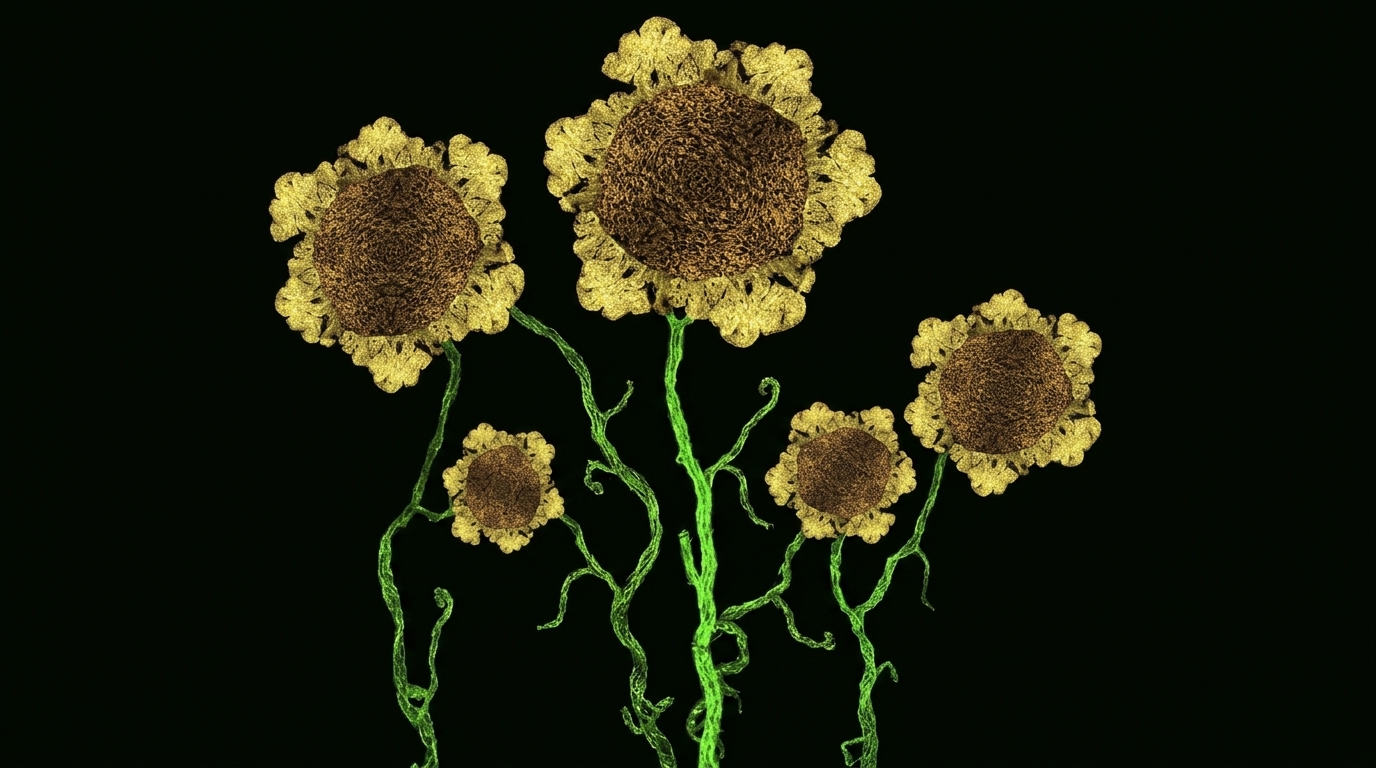
Ashleigh’s science-art transforms immunofluorescence confocal images of the urinary bladder into sunflowers, using art to bring chronic UTI into the light.
From the bladder’s microscopic layers, a sunflower blooms. CD31+ blood vessels (green) rise as stems and the detrusor muscle (brown) forms the inner disc. The urothelium (yellow), often shed during urinary tract infection (UTI), now radiates outward as golden petals—beautiful yet vulnerable.
As a global emblem of hidden disability, the sunflower here becomes a metaphor for chronic UTI—an unseen condition rendered visible through science and art, inviting reflection on resilience within fragility.
Where did your interest in medical research begin?
My dad has had experience with brain cancer, so growing up I was exposed to the medical environment and hospitals. I became really interested in trying to figure out how I could help in that space.
Then, through school, I came to really love science. I thought medical research was a way of bringing those two interests together.
I went to Monash University and completed a Bachelor of Biomedical Science and a Bachelor of Science as a double degree.
While I was there, I wanted to get experience working in a laboratory. Malcolm had a winter scholarship research position available, which was a four-week project.
I came along because it sounded really interesting.
And that four-week project eventually led you into urinary tract research?
Yes. I really came to love it.
UTIs are an interesting area because they’re incredibly common, particularly among women, yet they’re still a relatively underrepresented area of research.
They’re also something people don’t necessarily want to talk about. There’s a taboo around UTIs, despite how common they are.
I really liked the mucosal immunology aspect of the research and the fact that the work has the potential to make a really significant difference to the lives of so many people around the world.
Why science-art matters
For Ashleigh, creating scientific images isn’t simply about making research look beautiful.
Images can communicate science in a way that words sometimes can’t.
A complex microscopic process that might be difficult for someone without a scientific background to understand can suddenly become something familiar and emotionally engaging.
Her sunflower image provides a particularly powerful example.
The flower is familiar. The science hidden within it is not.
And that contrast creates an opportunity to start a conversation about chronic UTI.
It asks us to look more closely—both at the image and at a condition that has historically received less attention than its impact warrants.
What does Ashleigh hope for the future of UTI research?
Ashleigh believes there is an enormous opportunity to expand our understanding of urinary tract disease by looking beyond the bacteria themselves.
Understanding the interaction between infection and the host immune response could open up new avenues for research and, potentially, new approaches to treatment.
For chronic UTI in particular, understanding why an infection persists in some individuals while resolving in others could be an important piece of the puzzle.
And perhaps just as importantly, Ashleigh hopes urinary tract research will receive greater recognition.
UTIs affect so many people, yet there is still so much we don’t understand.
Her work is part of a growing effort to change that.
Bringing chronic UTI into the light
Ashleigh’s sunflower image captures something that is at the heart of both her research and the work of Chronic UTI Australia.
There is a whole world happening beneath the surface.
At first glance, we see a beautiful sunflower.
Look more closely, and we see the microscopic structures of the urinary bladder.
Look beyond the image, and we see a young researcher working to understand why some urinary tract infections persist—and how a better understanding of the immune response might ultimately help people living with chronic urinary tract disease.
Science can sometimes feel distant or inaccessible.
Ashleigh’s work shows us that it can also be beautiful, creative and deeply human.
Through her research and her art, Ashleigh is helping to make chronic UTI more visible—and reminding us why there is still so much more to discover.
About Ashleigh Paschek

Ashleigh Paschek is a PhD scholar working with Dr Malcolm Starkey in the Urinary Tract Disease Research Group at the School of Translational Medicine, Monash University. Her research focuses on the host immune response to urinary tract infection, including investigating factors that may contribute to persistent infection and potential biomarkers and therapeutic targets associated with chronic UTI.
A closer look at the research behind the images
The Bladder and Kidney Health Discovery Program at Monash University is a collective bringing together researchers working across bladder and kidney health.
The program has hosted the Bladder and Kidney Health Symposium in 2024 and 2025, bringing together researchers and clinicians and providing a platform for discussion around bladder and kidney research.
The program has also supported research through seed funding opportunities, including funding for projects investigating bladder and kidney health.
For Ashleigh and the Urinary Tract Disease Research Group, this broader research environment provides an opportunity to bring greater attention to an area of science that has historically received less focus.
Want to know more?
Learn more about the Bladder and Kidney Health Discovery Program https://www.monash.edu/medicine/translational/research/bladder-and-kidney-health
Learn more about the Urinary Research Group: https://www.monash.edu/medicine/translational/immunology/research/urinary-tract-disease
A big thank you to our appreciated supporter and sponsor


Written by Sally Murali
Online Communications /Digital Reach
Chronic UTI Australia Inc., 2026
0 Comments